
Cricket matches between India and New Zealand have consistently attracted attention because both teams bring different strengths, tactical approaches and competitive spirit to the field. India are known for their batting depth and spin-bowling resources, while New Zealand have developed a reputation for disciplined fast bowling, intelligent field placements and fighting performances under pressure. Their encounters often produce memorable individual performances and important moments that influence the outcome of a series.
The new zealand national cricket team vs india national cricket team match scorecard is particularly interesting for fans who want more than just the final result. A detailed scorecard explains how each innings developed, which batters contributed important runs, how bowlers controlled the game and where the momentum shifted. It also provides useful statistics such as strike rates, economy rates, partnerships, extras and fall of wickets.
One of the latest major meetings between the teams took place in the fourth ODI of India’s 2026 tour of New Zealand at Bay Oval in Mount Maunganui on November 13. New Zealand produced a remarkable performance, scoring 333 runs before dismissing India for just 89. The hosts secured a 244-run victory, making it an important match for understanding both teams’ performances.
New Zealand vs India Fourth ODI: Match Overview
The fourth ODI was played at Bay Oval, Mount Maunganui, with India winning the toss and choosing to bowl first. New Zealand used the opportunity to establish a strong total through an excellent batting performance. Will Young played a particularly important role, scoring 125 runs from 108 deliveries. His innings included 14 boundaries and four sixes, providing the foundation for the home team’s competitive total.
India entered the match with an opportunity to continue their series momentum, but New Zealand’s batters and bowlers made the contest difficult. Tim Seifert supported Young with 58 runs, while Finn Allen added 41. New Zealand eventually reached 333 runs in 50 overs. India’s response never developed as expected because Matt Henry produced an outstanding opening spell that immediately placed the visitors under pressure.
New Zealand National Cricket Team Batting Scorecard
New Zealand’s batting performance was built around a combination of controlled stroke play and aggressive scoring. Will Young anchored the innings, while Tim Seifert and Finn Allen provided valuable support. The opening partnership gave New Zealand a positive start, and Young continued to build his innings even after wickets began falling. His century was the central feature of the innings because it allowed the middle order to play with greater freedom.
New Zealand Batting Scorecard
| Batter | Runs | Balls | 4s | 6s |
|---|---|---|---|---|
| Will Young | 125 | 108 | 14 | 4 |
| Tim Seifert | 58 | 48 | 6 | 3 |
| Nick Kelly | 4 | 8 | 0 | 0 |
| Dean Foxcroft | 8 | 13 | 0 | 0 |
| Finn Allen | 41 | 30 | 5 | 2 |
| Michael Bracewell | 15 | 20 | 1 | 0 |
| Mitchell Santner | 24 | 29 | 1 | 2 |
| Kristian Clarke | 22 | 22 | 1 | 1 |
| Kyle Jamieson | 19* | 21 | 1 | 0 |
| Matt Henry | 2 | 2 | 0 | 0 |
| Matthew Fisher | 1 | 1 | 0 | 0 |
| Extras | 14 | — | — | — |
| Total | 333 | 50 overs |
*Not out. Source: Match scorecard.
The innings featured several useful partnerships. Young and Seifert added 85 runs for the opening wicket, creating a strong platform. Young then combined with Finn Allen for another important 90-run partnership. Allen’s attacking approach helped maintain the scoring rate, while Young continued rotating the strike and finding boundaries. Mitchell Santner, Kristian Clarke and Kyle Jamieson also contributed during the later overs, ensuring New Zealand reached 333 despite losing their final wickets in the closing stages.
India National Cricket Team Batting Scorecard
India’s batting innings was a major disappointment for the visiting team. Chasing 334 runs, the visitors needed a confident start from their top order. However, the opening overs produced a dramatic collapse that completely changed the direction of the match. Rohit Sharma was dismissed without scoring on the first delivery, and Virat Kohli and Shreyas Iyer also departed without opening their accounts.
The new zealand national cricket team vs india national cricket team match scorecard highlights how difficult India’s chase became after losing three wickets without scoring. Ruturaj Gaikwad was dismissed for five, leaving India at nine runs for four wickets. This early collapse created enormous pressure on the remaining batters, who had to rebuild the innings while also keeping the required run rate in mind.
Ishan Kishan attempted to provide some stability with 27 runs from 53 deliveries. Axar Patel and Naman Dhir also scored 21 runs each, but their contributions were not enough to create a meaningful recovery. New Zealand’s bowlers continued taking wickets at regular intervals, and India were eventually dismissed for 89 in 26.4 overs.
India Batting Scorecard
| Batter | Runs | Balls | 4s | 6s |
|---|---|---|---|---|
| Rohit Sharma | 0 | 1 | 0 | 0 |
| Ruturaj Gaikwad | 5 | 13 | 0 | 0 |
| Virat Kohli | 0 | 4 | 0 | 0 |
| Shreyas Iyer | 0 | 1 | 0 | 0 |
| Ishan Kishan | 27 | 53 | 4 | 0 |
| Axar Patel | 21 | 36 | 3 | 0 |
| Naman Dhir | 21 | 24 | 0 | 2 |
| Auqib Nabi | 5 | 8 | 1 | 0 |
| Kuldeep Yadav | 1 | 4 | 0 | 0 |
| Gurnoor Brar | 2 | 13 | 0 | 0 |
| Arshdeep Singh | 0* | 3 | 0 | 0 |
| Extras | 7 | — | — | — |
| Total | 89 | 26.4 overs |
*Not out. Source: Match scorecard.
New Zealand Bowling Performance
New Zealand’s bowling attack played a decisive role in the result. Matt Henry delivered an exceptional performance, taking six wickets for just 27 runs in 9.4 overs. His opening spell was particularly important because he dismissed Rohit Sharma, Virat Kohli and Shreyas Iyer during the first over. Such a start immediately placed India in a difficult position and gave New Zealand complete control of the contest.
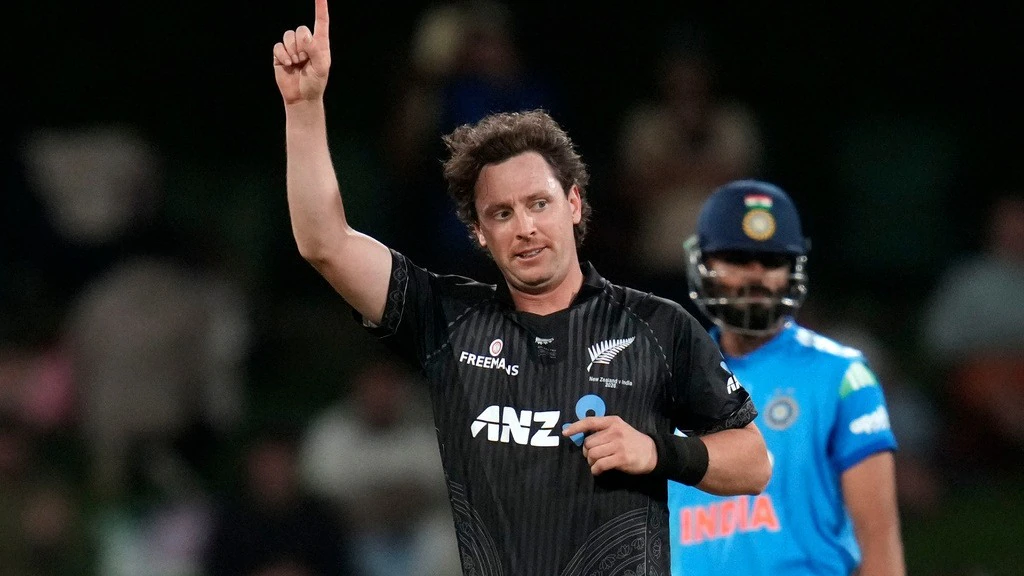
Matthew Fisher also made a significant contribution by claiming three wickets for 31 runs in seven overs. His ability to dismiss important middle-order batters prevented India from rebuilding the innings. Kyle Jamieson supported the attack with one wicket for 12 runs in six overs, including two maiden overs. The bowling figures demonstrate how New Zealand combined pace, accuracy and consistent pressure to restrict the visitors.
New Zealand Bowling Figures
| Bowler | Overs | Runs | Wickets |
|---|---|---|---|
| Matt Henry | 9.4 | 27 | 6 |
| Kyle Jamieson | 6 | 12 | 1 |
| Kristian Clarke | 2 | 13 | 0 |
| Matthew Fisher | 7 | 31 | 3 |
| Michael Bracewell | 2 | 6 | 0 |
India Bowling Performance
Although India lost the match by a considerable margin, some bowlers managed to produce useful performances during New Zealand’s innings. Axar Patel was among the more economical options, taking two wickets for 39 runs in ten overs. His ability to control the scoring rate provided India with some opportunities to slow down the opposition during the middle overs.
Auqib Nabi and Gurnoor Brar also claimed two wickets each, while Arshdeep Singh picked up one wicket. Naman Dhir contributed another breakthrough. However, India’s bowling attack struggled to prevent Young and the other New Zealand batters from building partnerships. Kuldeep Yadav conceded 73 runs in eight overs without taking a wicket, while the other bowlers also found it difficult to stop New Zealand from reaching a substantial total.
The match illustrated the importance of taking wickets without allowing partnerships to develop. India’s bowlers did manage to remove all ten New Zealand batters, but the hosts had already accumulated 333 runs. Defending such a total gave New Zealand’s bowlers considerable freedom to attack during the second innings.
Key Moments That Decided the Match
Several important moments shaped the outcome of this fourth ODI. New Zealand’s positive start, Young’s century and Henry’s opening spell were particularly influential. The contrast between the two innings demonstrated how quickly a cricket match can change when one side loses early wickets.
The new zealand national cricket team vs india national cricket team match scorecard also provides a clear picture of the difference between the two batting performances. New Zealand scored at 6.66 runs per over, whereas India’s scoring rate was only 3.34. This difference reflected New Zealand’s attacking approach and India’s struggle to establish partnerships.
Some of the most important moments included:
-
Will Young scoring a match-defining 125 runs.
-
Tim Seifert contributing 58 runs during the opening partnership.
-
Matt Henry taking three wickets in the opening over.
-
New Zealand dismissing India for 89 runs in 26.4 overs.
These moments collectively explain why New Zealand secured such a comprehensive victory.
Fall of Wickets and Match Momentum
The fall of wickets played an important role in determining the result. New Zealand lost their first wicket at 85 runs when Tim Seifert was dismissed in the 12th over. Although a few wickets followed, Will Young continued batting confidently and ensured that the innings did not lose momentum. His dismissal came at 256 runs, after he had already completed a valuable century and helped his team establish a strong position.
India’s innings followed a completely different pattern. The visitors lost their first three wickets without scoring, which created an extremely difficult situation. Ruturaj Gaikwad’s dismissal at nine runs made the recovery even harder. Ishan Kishan, Axar Patel and Naman Dhir attempted to stabilize the innings, but regular breakthroughs prevented them from forming a substantial partnership. India eventually lost all ten wickets at 89 runs.
The new zealand national cricket team vs india national cricket team match scorecard shows that India’s first four wickets fell for only nine runs. This statistic explains the extent of the early collapse and highlights the importance of New Zealand’s opening bowling spell.
Player of the Match and Outstanding Performances
Will Young and Matt Henry were the two standout performers for New Zealand. Young’s 125-run innings provided the batting foundation, while Henry’s six-wicket haul destroyed India’s top order and lower batting resistance. Both performances demonstrated how individual contributions can influence a team’s overall result.
Young showed excellent control throughout his innings. Instead of depending entirely on aggressive shots, he combined boundary scoring with regular strike rotation. His 108-ball century helped New Zealand maintain a strong scoring rate across the full 50 overs. Henry, meanwhile, used disciplined line and length to exploit India’s early batting difficulties.
India also had a few individual contributions worth recognizing. Ishan Kishan’s 27 and the 21-run efforts from Axar Patel and Naman Dhir were among the limited positive performances in the batting innings. However, these contributions could not compensate for the top-order collapse.
Series Situation After the Fourth ODI
The fourth ODI was important for the overall series because India had already won the opening two matches. New Zealand’s victory reduced the gap and gave the home team an opportunity to finish the ODI series on a positive note. Despite the heavy defeat, India remained ahead in the five-match series by 2-1.
The new zealand national cricket team vs india national cricket team match scorecard therefore needs to be understood in the context of the entire series rather than as an isolated result. India had demonstrated consistency in the earlier matches, while New Zealand showed that they could respond strongly when their batting and bowling units performed together.
The fifth and final ODI was scheduled for November 15, 2026, at Bay Oval in Mount Maunganui. It provided New Zealand with an opportunity to level the series and India with a chance to secure a 3-1 finish. The upcoming match also offered both teams an opportunity to evaluate their combinations before the scheduled Test series.
What Makes an India vs New Zealand Scorecard Important?
A cricket scorecard is much more than a record of runs and wickets. It helps supporters understand how a match developed and why a particular team won. For example, looking only at New Zealand’s final total of 333 does not explain the importance of Young’s century or the contributions from Seifert and Allen. Similarly, India’s final total of 89 does not fully explain how quickly the batting lineup collapsed.
The new zealand national cricket team vs india national cricket team match scorecard provides several statistical details that help readers understand the contest. Batting averages, strike rates, bowling economy, partnerships and fall-of-wickets information all contribute to a more complete picture. These statistics are also useful for cricket enthusiasts who enjoy comparing performances across different formats and series.
For example, a batter scoring 50 runs from 40 balls has a different impact on an ODI match compared with someone scoring 50 from 80 deliveries. Similarly, a bowler taking three wickets while conceding 25 runs offers a different contribution from a bowler who takes three wickets for 65 runs. Understanding these differences makes scorecard analysis more meaningful.
How to Read a Cricket Match Scorecard Correctly
New cricket followers sometimes find scorecards confusing because they contain abbreviations and numerical information. However, once the basic terms are understood, reading a scorecard becomes much easier. The batting section displays the runs scored, balls faced, boundaries and strike rate. The bowling section records overs, maiden overs, runs conceded, wickets and economy rate.
Some important scorecard terms include:
-
R (Runs): Total runs scored by a batter.
-
B (Balls): Number of deliveries faced.
-
SR (Strike Rate): Runs scored per 100 balls faced.
-
ECO (Economy): Average runs conceded per over by a bowler.
Another important detail is the extras column, which includes wides, no-balls, byes and leg-byes. These runs are added to the team’s total but are not credited to an individual batter. Understanding these details helps readers interpret the complete match statistics rather than focusing only on individual batting performances.
Why India vs New Zealand Cricket Matches Attract Attention
India and New Zealand have developed an interesting international cricket rivalry through several memorable encounters in Test matches, ODIs and T20Is. Both teams have produced talented players who have performed under different conditions. Indian batters often bring considerable experience and attacking ability, while New Zealand’s bowling combinations are known for using movement, accuracy and variations effectively.
The conditions in New Zealand can also make matches challenging for visiting teams. Grounds such as Bay Oval, Eden Park and Hagley Oval offer different playing conditions, and factors such as wind, pitch movement and weather can influence team strategies. Indian players must adjust their batting techniques and bowling plans to succeed in these conditions.
For supporters following the new zealand national cricket team vs india national cricket team match scorecard, these environmental factors add another layer of interest. A score that looks competitive on one ground may become easier or more difficult to chase depending on pitch conditions and the weather. This is why match statistics are best understood alongside the venue, playing conditions and team strategies.
Conclusion
The fourth ODI between New Zealand and India on November 13, 2026, produced a remarkable result at Bay Oval. New Zealand scored 333 runs in their allotted 50 overs, with Will Young’s outstanding 125-run innings providing the foundation. Tim Seifert and Finn Allen also made important contributions, helping the hosts establish a challenging target.
India struggled throughout the chase and were dismissed for just 89 runs in 26.4 overs. Matt Henry’s six-wicket performance and Matthew Fisher’s three wickets were central to New Zealand’s 244-run victory. Although India suffered a heavy defeat, they continued to lead the five-match ODI series 2-1 after the fourth match.
Overall, the new zealand national cricket team vs india national cricket team match scorecard offers a detailed understanding of an encounter defined by exceptional batting from Young and outstanding bowling from Henry. It highlights the importance of partnerships, early breakthroughs, bowling discipline and maintaining pressure throughout an ODI match. For cricket enthusiasts, this contest provides an excellent example of how a strong all-round team performance can completely change the direction of an international cricket match.

